A timeline from ancient nomads to the modern republic, with the rulers who shaped it
Last reviewed on 29 September 2026
The history of Kazakhstan runs from Bronze Age herders on the steppe to a modern republic that is barely thirty-five years old. Between those points sit the Saka horse warriors, the Silk Road cities of the Syr Darya, the Mongol conquest, a Kazakh Khanate founded in 1465, two centuries of Russian rule, seven decades of Soviet rule, and independence declared on 16 December 1991.
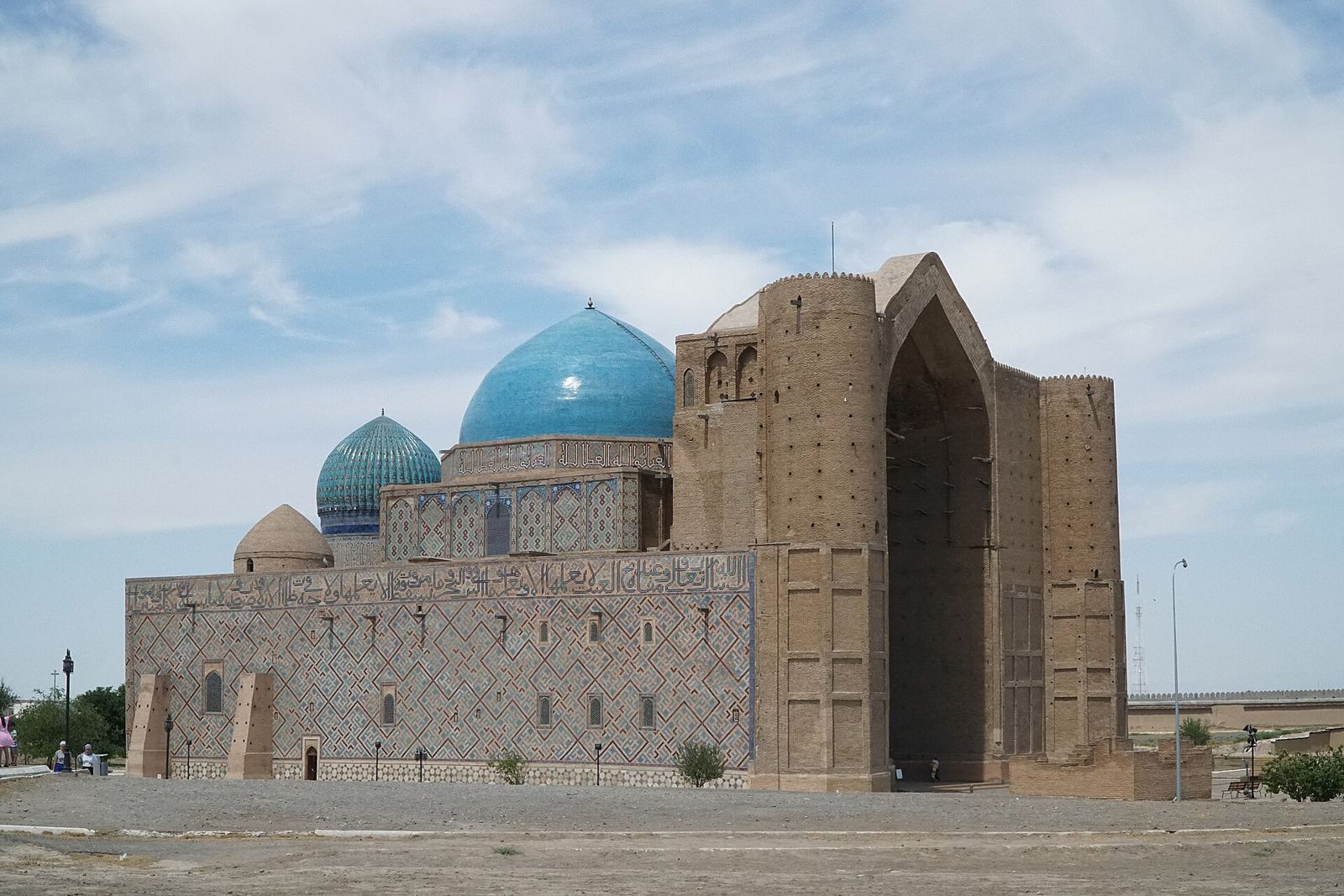
The Mausoleum of Khoja Ahmed Yasawi in Turkestan, begun on Timur's orders in the late 14th century and never finished. Photo: Adam Harangozó / CC BY-SA 4.0
History of Kazakhstan in brief
Nomadic confederations herded and fought across this steppe for three thousand years while caravan cities grew along its southern rivers. Genghis Khan swept through in 1219–1221 and the region became part of the Mongol empire, then of its successor khanates. In 1465 two sultans, Kerey and Zhanibek, broke away to found the Kazakh Khanate, which later divided into three zhuz — the Great, Middle and Little Hordes. Facing Dzungar invasion, the hordes accepted Russian protection from 1731 onward, and protection became annexation by the mid-19th century. The Soviet period brought forced settlement and a catastrophic famine in the early 1930s, then wartime deportations, the Virgin Lands campaign, the Semipalatinsk nuclear test site and the Baikonur cosmodrome. Kazakhstan was the last Soviet republic to declare independence, on 16 December 1991, and has had two presidents since: Nursultan Nazarbayev (1991–2019) and Kassym-Jomart Tokayev (2019–present).
When did Kazakhstan become a country?
It depends which founding you mean. As an independent state, Kazakhstan dates from 16 December 1991 — the last of the fifteen Soviet republics to declare independence, nine days before the USSR itself was dissolved. As a distinct Kazakh polity, the date usually given is 1465, when Sultans Zhanibek and Kerey led their followers away from the Uzbek Khanate into the Zhetysu valleys and founded the Kazakh Khanate; Kazakhstan marked the 550th anniversary of that event in 2015. And as a named territorial unit, an autonomous republic was created within Soviet Russia in 1920 (renamed the Kazakh ASSR in 1925) and became the Kazakh SSR, a full Soviet republic, in 1936.
Timeline of Kazakhstan: Key Dates
The dates below are the ones worth knowing before you visit the museums and monuments. Dates for the early periods are approximate.
Date
Event
c. 2000–1000 BCE
Bronze Age herders on the steppe; many of the Tamgaly petroglyphs near Almaty date from this period
c. 800–200 BCE
Saka (Scythian) nomads dominate the steppe; the Golden Man burial near Issyk dates from this era
552 CE
First Turkic Khaganate founded; Turkic peoples spread across the steppe
751
Battle of Talas, on the Talas River near modern Taraz: Arab Abbasid forces defeat Tang China, opening Central Asia to Islam
10th–12th centuries
Karakhanid state; Silk Road cities such as Otrar, Taraz and Sayram flourish
1166
Death of the Sufi poet Khoja Ahmed Yasawi in Turkestan (traditional date)
1219–1221
Mongol conquest under Genghis Khan; Otrar is destroyed
13th–15th centuries
Region ruled by the Golden Horde and other Mongol successor khanates
c. 1389–1405
Timur orders the Yasawi Mausoleum built in Turkestan
1465
Kerey and Zhanibek found the Kazakh Khanate
1723
Dzungar invasion — the "Years of Great Disaster" (Aqtaban Shubyryndy)
1731
Abulkhair Khan of the Little Zhuz accepts Russian protection
1822–1848
Russia abolishes the khans' authority in all three zhuz
1837–1847
Revolt of Kenesary Kasymov, the last Kazakh khan
1854
Russian fort of Verny founded — today's Almaty
1916
Central Asian revolt against wartime labour conscription
1917–1920
Alash Orda, a short-lived Kazakh autonomous government
1920
Autonomous republic created within Soviet Russia (named Kazakh ASSR in 1925)
1930–1933
Collectivisation and famine (Asharshylyq); an estimated 1.5 million or more people die
1936
Kazakh SSR becomes a full Soviet republic
1930s–1940s
Mass deportations of Koreans, Volga Germans, Chechens and others to Kazakhstan
1949
First Soviet nuclear test at the Semipalatinsk Test Site
1954–1960
Virgin Lands campaign brings large-scale grain farming and settlers to the north
1955
Baikonur Cosmodrome founded; Yuri Gagarin launched from it in 1961
December 1986
Jeltoqsan protests in Alma-Ata after a non-Kazakh is appointed party leader
29 August 1991
Semipalatinsk Test Site closed
16 December 1991
Independence declared; Nursultan Nazarbayev becomes president
1995
Current constitution adopted by referendum (30 August, now Constitution Day)
1997
Capital moves from Almaty to Akmola, renamed Astana in 1998
Nationwide unrest, known as Qandy Qantar ("Bloody January")
2022
Constitutional reforms; presidency limited to one seven-year term; capital renamed Astana again
The Main Periods of Kazakh History
Ancient Period (to the 6th Century CE)
Bronze Age: Herding cultures (often grouped as the Andronovo culture) spread across the steppe and left rock art such as the Tamgaly petroglyphs
Saka Period (c. 800–200 BCE): Scythian nomads inhabited the steppes, known for skilled horsemanship and elaborate gold craftsmanship (the Golden Man of Issyk)
Silk Road: Trade routes crossed southern Kazakhstan, bringing wealth and cultural exchange
Turkic and Mongol Period (6th–15th Century)
Turkic khaganates: Rise of Turkic peoples, the linguistic ancestors of today's Kazakhs
Islam arrives: After the Battle of Talas (751), Islam spreads through the southern oasis cities of Otrar, Taraz, Sayram and Turkestan
Mongol conquest (1219–1221): Genghis Khan's armies sweep through Central Asia
Golden Horde: Mongol successor states rule the steppes for around two centuries
Kazakh Khanate (1465–1847)
Formation (1465): Kazakh Khanate established under Kerey and Zhanibek
Three Zhuzes: Division into Great (Senior), Middle and Little (Junior) Hordes
Golden Age: Peak under Kasym Khan in the early 16th century
Dzungar wars: A long struggle in the 17th and 18th centuries that pushed the hordes towards Russia
Russian Empire Period (1731–1917)
Gradual incorporation: Little Zhuz sought Russian protection (1731)
Colonial expansion: Middle and Great Zhuzes annexed by the mid-1800s, with Russian forts and settlers following
Resistance: Revolts led by Syrym Datuly, Isatai Taimanuly and Kenesary Kasymov, and the 1916 uprising
Alash Orda (1917–1920): Short-lived autonomous Kazakh government
Soviet Era (1920–1991)
Kazakh SSR (1936): Kazakhstan becomes a full Soviet republic
Collectivisation (1930s): Forced settlement of nomads caused a famine that killed an estimated 1.5 million or more people, a large share of all Kazakhs
Deportations: Whole peoples were exiled to Kazakhstan, and the Gulag had large camps here, including Karlag near Karaganda
Virgin Lands Campaign (1950s): Mass agricultural development of the northern steppe
Nuclear testing: Semipalatinsk Test Site (1949–1989), where 456 nuclear tests were carried out
Space programme: Baikonur Cosmodrome established (1955)
Capital: Alma-Ata (Almaty) developed as a major Soviet city
Independence Era (1991–Present)
Independence (16 December 1991): Last Soviet republic to declare independence
Nuclear disarmament: Kazakhstan gave up the Soviet nuclear weapons left on its soil in the mid-1990s
Economic reforms: Transition to a market economy and oil-driven growth
New capital (1997): Astana became the capital (called Nur-Sultan from 2019 to 2022)
Multi-vector policy: Balancing relations with Russia, China and the West
Reforms after 2022: Constitutional changes following the January 2022 unrest
Rulers of Kazakhstan: Khans, Soviet Leaders and Presidents
Kazakhstan has never had a single unbroken line of rulers. Power passed from the khans of the Kazakh Khanate, to Russian governors, to the Communist Party leaders of the Kazakh SSR, and finally to the presidents of the independent republic. These are the names you will meet on street signs, banknotes and monuments. Reign dates for the khans are approximate, as sources differ.
Key khans of the Kazakh Khanate
Kerey and Zhanibek (from 1465): Founders of the Kazakh Khanate
Kasym Khan (c. 1511–1521): Expanded the khanate to its greatest early extent and is credited with its first law code
Khaknazar Khan (c. 1538–1580): Reunited the Kazakhs after a period of decline
Esim Khan (c. 1598–1628): Took Turkestan, which became the khanate's capital
Tauke Khan (c. 1680–1715): Associated with the Zheti Zhargy ("Seven Codes"), the customary law of the steppe
Abulkhair Khan (Little Zhuz, 18th century): Led resistance to the Dzungars and accepted Russian protection in 1731
Ablai Khan (1711–1781): The most celebrated khan, who united much of the Kazakh people and balanced Russia against Qing China
Kenesary Kasymov (1802–1847): Grandson of Ablai and the last khan, killed in 1847 after a decade-long revolt against Russian rule
Leaders of Soviet Kazakhstan
In the Soviet system the real leader of a republic was the First Secretary of its Communist Party. The best known are:
Filipp Goloshchyokin (1925–1933): Led the collectivisation campaign that caused the famine
Zhumabay Shayakhmetov (1946–1954): The first ethnic Kazakh to lead the republic's party
Leonid Brezhnev (1955–1956): Ran the Virgin Lands campaign here before becoming Soviet leader
Dinmukhamed Kunaev (1960–1962 and 1964–1986): The longest-serving Soviet-era leader of Kazakhstan
Gennady Kolbin (1986–1989): His appointment in place of Kunaev sparked the December 1986 protests
Nursultan Nazarbayev (1989–1991): Became party leader in 1989 and led the republic to independence
Presidents of Kazakhstan
Nursultan Nazarbayev (1991–2019): First president, who oversaw independence, the move of the capital to Astana and the oil boom
Kassym-Jomart Tokayev (2019–present): Second president, re-elected in 2022 for a single seven-year term
Other Key Historical Figures
Tomyris: Legendary Saka (Massagetae) queen said to have defeated Cyrus the Great (6th century BCE)
Al-Farabi (c. 870–950): Philosopher born near Otrar, after whom Almaty's main university is named
Khoja Ahmed Yasawi (died c. 1166): Sufi poet and teacher whose mausoleum in Turkestan is the country's holiest site
Chokan Valikhanov (1835–1865): Scholar, ethnographer and explorer
Abai Qunanbaiuly (1845–1904): The greatest Kazakh poet and philosopher
Alikhan Bokeikhanov (1866–1937): Leader of the Alash Orda government, executed in Stalin's purges
Ancient Silk Road city and former Kazakh capital, home to the Mausoleum of Khoja Ahmed Yasawi (UNESCO World Heritage Site) and the spiritual centre of the Turkic world.
Otrar
Ruins of the city destroyed by Genghis Khan in 1219–1220, reachable as a day trip from Turkestan or Shymkent.
Tamgaly Petroglyphs
UNESCO World Heritage Site with thousands of rock carvings, many from the Bronze Age, a few hours' drive from Almaty.
Kazakhstan declared independence from the Soviet Union on 16 December 1991, the last of the fifteen Soviet republics to do so. Independence Day is still celebrated on 16 December.
When was the Kazakh Khanate founded?
The Kazakh Khanate was founded in 1465 by Kerey and Zhanibek, and lasted until the Russian Empire abolished the khans' authority in the first half of the 19th century. Kenesary Kasymov, killed in 1847, is regarded as the last khan.
Who have been the presidents of Kazakhstan?
Kazakhstan has had two presidents: Nursultan Nazarbayev from 1991 to 2019, and Kassym-Jomart Tokayev from 2019 to the present.
Why was Astana renamed Nur-Sultan and back again?
The capital, Astana, was renamed Nur-Sultan in honour of Nursultan Nazarbayev when he stepped down in 2019. After the unrest of January 2022 and the political reforms that followed, it was renamed Astana again in September 2022.
Was Kazakhstan part of the Soviet Union?
Yes. Kazakhstan was a Soviet republic from 1920 (first as an autonomous republic within Russia, then as the Kazakh SSR from 1936) until independence in December 1991.
Explore Kazakhstan's Heritage
From ancient civilisations to modern independence, Kazakhstan's history comes alive through its people, monuments and traditions.